
Why an AI-generated version of a Keith Haring painting is causing controversy online
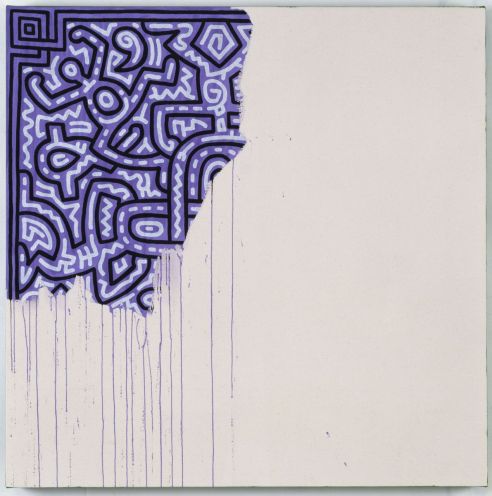
A purposely unfinished painting by late artist Keith Haring has been manipulated to look complete using AI, and it is causing much debate online about copyright issues and, just as importantly, respect for artists’ intentions and the meanings behind their work.
Controversy erupted online when an X user adopted artificial intelligence to ‘complete’ Keith Haring’s Unfinished Painting from 1989. The original artwork fills only the top left corner of the canvas, with the rest of the area intentionally left blank to represent the void caused by the late ’80s HIV/AIDS epidemic.
Haring himself died of AIDS on February 16, 1990, only a few months after he’d created his Unfinished Painting.
The original artwork features paint on just one quarter of the canvas – covering most of the top left, with the rest purposefully left blank as a commentary on the HIV/AIDS epidemic that took the lives of millions around the world, mainly from the LGBTQ+ community (at the time).
In a recent X post, user @DonnelVillager shared an image of the artwork – now entirely filled through generative A.I. software. “The story behind this painting is so sad!” wrote @DonnelVillager. “Now using A.I. we can complete what he couldn’t finish!”, assuming Haring hadn’t kept three quarters of the painting blank on purpose.
While Haring’s original work features a rhythmic purple pattern of the artist’s famous ‘outline men’ in the top left corner, the AI ‘extended version’ is clearly rougher in design, lacking the more intricate nuances of Haring’s art.
Squiggles replace what should look more like dots and there’s less a representation of outlined men and more a mess of tangled bodies. Critics online have called the AI-generated piece “disrespectful,” “disgusting,” and a “desecration”, while some went in the opposite direction, praising the capabilities of artificial intelligence for “showing us a world without AIDS” [sic].
One daft X user @aodanhill went so far as to write that “Lots of people angry about this, but I used AI to figure out how Keith would feel and it seems he is happy with the outcome. Good job!”.
This situation follows widespread concern about artificial intelligence and copyright issues. On December 31st, 2023, storyboard artist Jon Lam took to X to share a Google spreadsheet that listed thousands of artists whose works have been used to assist AI software companies like Midjourney in replicating artworks. Many notable artists appear on the spreadsheet, including Banksy, Salvador Dali, Yoko Ono, Tracey Emin, along with Keith Haring.
Currently, there is an ongoing class action suit against Midjourney and Open AI, claiming these AI-generating companies are stealing creator content without consent or copyright. In fact, things are more than just alleged. OpenAI recently defended its work by claiming “it would be impossible to train today’s A.I. models without using copyrighted materials.”
It went on to say, “Limiting training data to public domain books and drawings created more than a century ago might yield an interesting experiment, but would not provide A.I. systems that meet the needs of today’s citizens.”
The AI copyright debate is sure to continue as more and more online users adopt the abovementioned software to create alternative artworks.


Discover more from
Subscribe to get the latest posts sent to your email.
