
The reason you keep hearing Milli Vanilli’s music in Ryan Murphy’s new season of ‘Monsters’

Ryan Murphy is renowned for his heavily stylised productions – every set, prop and costume purposely selected to create the picture-perfect scene. Colour schemes are contemplated to the Nth degree, and costumes and props all carefully coordinated – particularly for period sets (of which Murphy has created many) where entire eras are created with carefully constructed backdrops, perfectly coordinated wardrobes, and precisely suited bric-a-brac. But Murphy doesn’t stop there, ensuring that the soundtracks to his productions are also pitch-perfect. In season five of American Horror Story: Hotel, for example, which is set in a haunted hotel in the heart of Los Angeles, ghosts of hobos and heroin junkies linger and you couldn’t imagine a more appropriate song to go with the eerie vibes than The Eagles’ Hotel California. It’s obvious and it works.
In his new limited series Monsters: The Lyle and Erik Menendez Story, Murphy tells the story of two brothers, Lyle and Erik Menendez, who murder their rich parents, José and Kitty Menendez, leaving the courts and public wondering if their motive was one of self-defense or absolute avarice. To present this convoluted tale, Murphy and his production team fill the screen with lavish, over-the-top mise en scène (that’s French for ‘stuffing the picture with’) and a soundtrack of songs that connote a certain tackiness, gaucheness and unabashed fakery (eg: Ice Ice Baby by Vanilla Ice – which is really just the gluttonous artist poaching the better parts of Queen and David Bowie’s Under Pressure).

On the aesthetic front, everything onscreen looks ostentatious – from the Menendez’s gaudily decorated mansion to boutiques brimming with designer wares, fast cars and excessive accessories to lashings of cocaine snorted off gold-gilded mirrors – all excellently representing the late 1980s just before the great global market crash. Even the brothers’ limousine ride to their parents’ funeral is gaudier than you’d expect for a somber event (personally, I’ve always found limousines too lavish for funerals) – the lads coming across as brash and obnoxious while the schmalzy strains of Kenny G’s Songbird ensures that things are kept at a more appropriately anaesthetised level, if only just.

Suddenly, one of the brothers, Lyle, is irritated by the song and asks the driver to change it, and that’s when the soundtrack turns full hilt into a Milli Vanilli best-of compilation. The familiar sampled beat of Girl You Know It’s True blares from the limo radio speakers, a celebratory vibe in contrast to the somber one that is generally sensed as one heads to a funeral.
At the service itself, Lyle then plays Milli Vanilli’s Girl I’m Gonna Miss You as a ‘tribute’ to his mother. It’s an odd song selection for several reasons. Its sentiment is cheap and tacky, to start with. Also, why is a son playing a cheesy love song in memory of his mother at her very funeral? Already, thoughts of possible incestuous relationships within the family begin to play out in the viewer’s mind.

Later that same episode, when Lyle and Erik have finally gotten around to buying shotguns to kill their parents with, the radio plays Milli Vanilli’s Blame It on The Rain, the word ‘blame’ perfectly suited to the thoughts likely going through the brothers’ minds: two sons about to murder their parents, already wondering what alibis they might concoct when investigations begin to pan out.
There’s plenty of Milli Vanilli music in there already – and that’s just the first episode. But why so much?
Milli Vanilli, for those not familiar with late 1980s pop music, were a duo from Germany, masterminded by Frank Farian, the founder of Boney M. Only the master eventually got caught out. The duo consisted of Fab Morvan and Rob Pilatus – friends who couldn’t actually sing but who possessed the supposed right ‘look’ for pop stardom. But while Morvan and Pilatus looked the perfect pop stars, they couldn’t sing for shit and would subsequently lip-sync to songs on stage and of course in music video. The actual singing was done by session artists Brad Howell and John Davis, who never received credit in Milli Vanilli’s album notes and, to extend the lark further, the music producers roped in female singers (namely sisters Jodie and Linda Rocco) to provide some of the higher notes that Milli Vanilli faked were theirs.
When you consider Milli Vanilli’s short-lived career – bookended by insincere love songs that weren’t even sung by them – you can understand why the pseudo-sonic duo’s music makes up most of the soundtrack to a story about two brothers who murder their parents, then have to defend themselves by revealing a covered-up life of abuse, or cooking up half-cocked stories for abuse they’ve caused and are covering up themselves: either, both, anything to avoid the death sentence. Lyle and Erik Menendez, in effect, are Milli Vanilli.
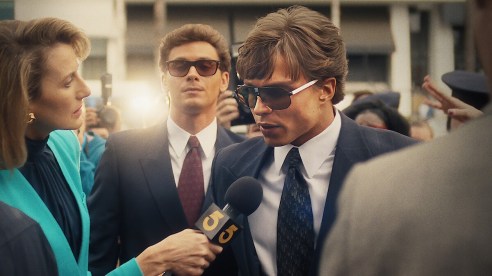
If the story they share in court is true – that they were sexually abused by both their parents and in the name of defense had to kill their parents – then the pseudo life of luxury and a close-knit family presented to their relatives and friends is a false one. If they weren’t abused and made up the story (or were coaxed by their counsel to), mainly to avoid the gas chamber, they get stuck with the fake tag, too. And if any incestuous goings-on that happened was always between the brothers themselves and nothing to do with the mother or father, then that’s one fucked-up, Freudian nightmare that would have to be padded out with nothing but falseness and fakery. Imagine trying to keep that situation from family, friends, and even inmates in jail?

Whatever the case might actually be, Milli Vanilli on music duty was the perfect call on Ryan Murphy’s behalf. The story is majorly made up but the people will know for sure… The story is all true (“Girl, you know it’s true”) but the people will never really know for sure… The industries – music, legal, political – are all corrupt but the people will never really know for sure… And if they do find out the truth, something else will come along (indeed, O.J. Simpson went to court on charges of murder and was acquitted – in between the two Menendez trials) which will make us forget and forgive the dodginess of it all.

The truly tragic aspect of the Menendez story is that it doesn’t even touch on the father’s connection to the hideous scene that is the late 1980s music industry – where sexual abuse and financial corruption ran rampant, and continued to do so into the 1990s, possibly still going on today (just ask Kesha). Personally, I’ve heard stories that the Menendez patriarch also played a part in abusing and ruining the lives of a couple of Menudo members (Menudo were the band José Menendez managed, making millions from their success) . My best friend was actually in the band for a proverbial five minutes and even in his short stint with the group, definite examples of abuse were witnessed. Abuse – mental, physical and certainly sexual – runs rampant in the music industry, and I’m fairly certain we’ll be seeing outright examples of it in future seasons of Monsters. Put it this way, Ryan Murphy and Co will never be short of monster material – nor tacky soundtracks to go with the sordid stories.
‘Monsters: The Lyle and Erik Menendez Story’ is streaming now on Netflix.

Discover more from
Subscribe to get the latest posts sent to your email.

Leave a Reply