
‘Saturday Night’: one giant supercut of an advert for a sketch series that’s now seemingly reductive
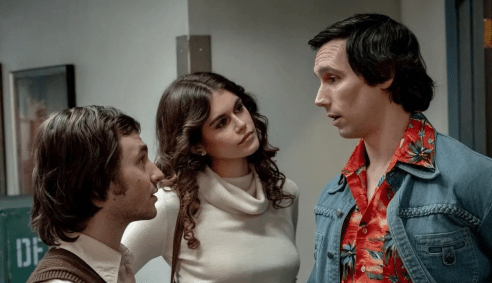
I’m not sure why I’m writing a review on Saturday Night – the film about the one-and-a-half hours that lead up to the start of the first-aired episode of comedy sketch series, Saturday Night Live. It kind of feels redundant.
It’s set in 1975 – a year whose aesthetic I remember very well, even though I was only five (cigarette smoke everywhere, fabulously repulsive fashions, sexist agendas) and one that could have been captured better on celluloid if it weren’t for some other ulterior agenda.
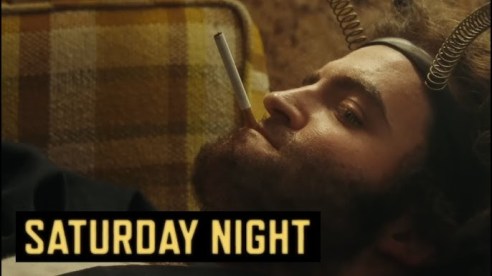
I’m Australian and I do love comedy. And I’ve watched a lot of American comedy on television and the net over five decades. But every time I’ve watched an episode of Saturday Night Live, I get a sense of excitement at first, and then am disappointed two minutes into a sketch because it suddenly turns into an American joke that I don’t really get. Even as an adult I’m often perplexed.
For example, leading up to the US elections, there have been plenty of sketches on the show that seemingly take the piss out of both presidential candidates, Donald Trump and Kamala Harris, but you still sense there’s a certain partisanship in there – favouring a certain political party.
Just when Maya Rudolph is doing an excellent impersonation of Kamala Harris – throwing in word salads and highlighting Harris’s typical no-answer nonsense, suddenly the character appears to come across as redeemable and likeable. Where is the poking-fun at Harris’s total lack of policy? Where are the hints of her partner Doug Emhoff’s extra-marital affairs and bad handling of women? Whereas anyone being imitated from the right side of the aisle appears to see the ‘applause’ audio increased by quite a few decibels.
As Russell Brand said recently, “Cultural artefacts and conduits that used to be legitimate – media like Rolling Stone and SNL – all of them now are corrupted and inept; themselves becoming ciphers of hollowness and emptiness.”
I myself can’t help but think that Saturday Night Live’s formula of ‘Harris = silly but ultimately good / Trump = stupid and ultimately bad’ becomes more pronounced weekend after weekend. After a while, even the audience’s laughter starts to sound canned, and the ‘Live’ in the show’s title ends up being redundant.
Similarly, post-production tactics appear to have been adopted in the making of Saturday Night, the film that pays tribute to the show’s opening episode from all those years ago. There’s editing, editing, lots of quick editing. And while I do love a good supercut or fast-paced montage now and then – having been raised by MTV as a kid – it gets a bit much over the course of an hour and a half. Jokes barely get to sink in; re-enacted skits (sorry, sketches) lose their full effect due to being cut short for the sake of cinematic brevity; and there’s just so much overlapping of audio, you hardly know who’s playing who saying what when and where.
Characters move from back alleys behind studios through corridors packed with people not really doing anything in their jobs, to green rooms and dressing rooms and back, all the while giving the viewer vertigo they didn’t pay for.
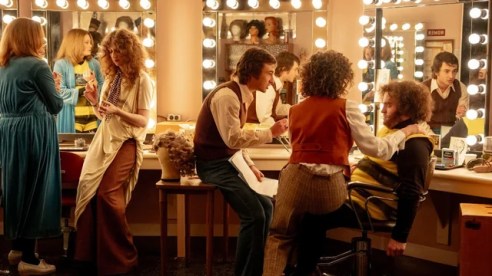
While such quick-cutting might look normal to your younger audiences, who can multitask with military precision, the film is obviously not aimed at them (Gen Z onward don’t particular care about icons – let alone comical ones).
I also suspect this film was made less to pay homage to a host of brilliant comedians and more as a promotion of a gritty-but-cool New York to the rest of the world so that that all-important tourism dollar (which has been lacking lately) begins to treacle back in.
Comedy plays a big part in the global economic system. It’s the relief we get in the evening after slaving away at our nine-to-five jobs; the fun breaks we have TikTok-ing and Insta-scrolling when we manage to duck away from the desk for a minute during work hours. Without comedy, our lives would be dismal.
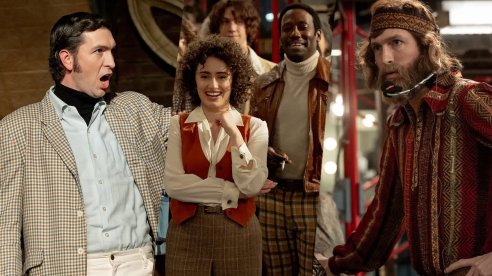
Part of the comedic picture is for community groups and nations to poke fun at themselves, but American comedians have never really been very good at that. They’ve gotten better over the decades, but don’t quite manage to be able to laugh at themselves as well as, say, Australians or the British do. In fact, American often pokes fun at the wrong people. Just think of what US president Joe Biden said this week about Trump supporters (and therefore about half the US population) being “garbage”. Biden was trying to come across with old-school banter but he ended up sounding like an absolute asshole (spelt the US way, which I always find oddly spelt -are Americans scared to say things as they really are?).
Each Saturday night, live on television, Saturday Night Live not only entertains millions of viewers, it holds the power to shape a nation according to certain directives – whether they be federal, partisan, or even coming from a deeper state. SNL is imperative in the American (pop) cultural and therefore political landscape. It holds, then, a responsibility to play fair when it comes to politics, but instead it plays things dirty and, worse still, deceitfully.
I can’t help but think the new movie ‘Saturday Night’ is pretty much one big ad for a TV series posited to play with viewers’ minds about who to vote for or not vote for; what bullshit to ultimately buy and what truths to quash under the barrage of silliness.
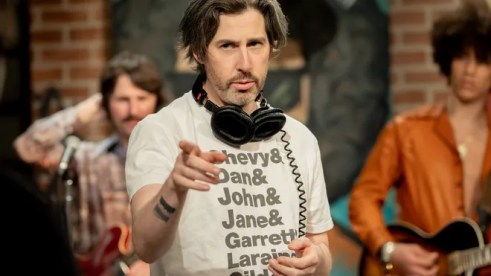
But then, that’s what gives Saturday Night, the film, a certain redemption – the fact that while today’s comedians need to mind their Ps and Qs, and might even be edited to a degree to suit biased politics, the comedic stars of the 1970s and ’80s let it rip and got to tell the jokes their way. Gilda Radner, Dan Ackroyd, Bill Murray, Lorraine Newman, Chevy Chase, and even mad-but-genius Andy Kaufman – they all said their piece their way. It’s a pity the film only gives you part of their excellent quips, rarely even hearing out the punchlines. Instead, there’s too much ‘Where’s John Belushi’ and not enough ‘Where’s John Belushi’s anti-establishment rhetoric?’.

“Have you seen John Belushi?” Yes, too often.
That’s what improv comedy is meant to be about: saying what’s at top of mind and relevant to the subject at hand; battling the evils of commerce and ordinariness, authority and false notions of niceness and democracy. Improv ought never be edited.
I believe the job of good comedy is not only to make us laugh and feel good, but to elevate consciousness a couple of notches. Not to be dumbing down the masses. Saturday Night, the movie, and Saturday Night Live, the series, especially lately, don’t appear to be doing the elevation thing very well. Sadly, while viewing the film tribute, I felt I was watching the opening titles to a movie about a popular TV show about the surrealness of the world as it once was. Waiting and waiting for the film to start. Only it never really did.
‘Saturday Night’ is in cinemas now.
Discover more from
Subscribe to get the latest posts sent to your email.

Leave a Reply