
Technical SEO Fundamentals for a Future-Proof Website

As the digital world evolves at a relentless pace, a website’s technical foundation often determines its ongoing success and visibility in search. Mastering the basics of technical SEO is essential if you want your site to attract potential customers and establish credibility in today’s competitive environment. Technical SEO goes beyond content optimization — it ensures your site’s infrastructure allows search engines to easily access, understand, and rank your pages, maximizing their potential to reach your target audience. Without a solid technical SEO strategy, even the most brilliant content can remain unseen by the audiences who need it most. From page speed and site architecture to mobile usability and security, technical SEO is the silent engine that powers lasting visibility and user satisfaction. By taking a proactive, future-focused approach, you lay the groundwork not only for improved search rankings but also for sustainable business growth.
Understanding Technical SEO
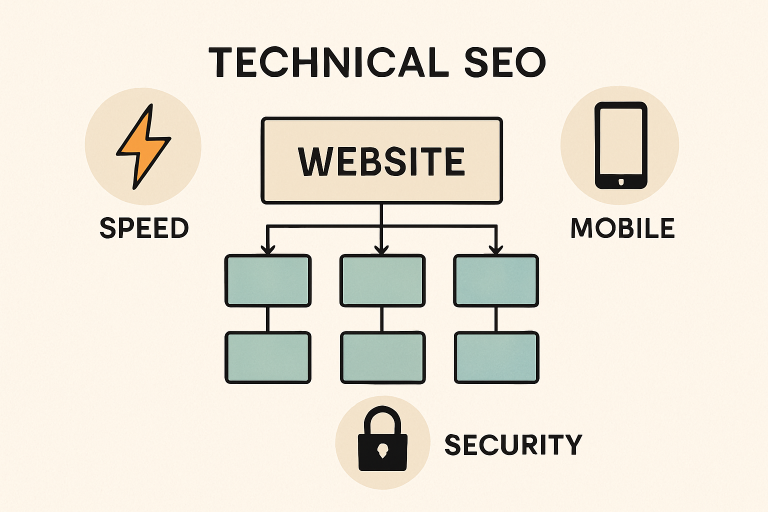
Technical SEO encompasses the backend improvements required to make a website easily discoverable by search engines. Distinct from content or off-site SEO, it addresses core site elements that influence how effectively search engines crawl, interpret, and index your pages. These can include site loading times, navigational ease, secure connections, and mobile compatibility.
A strong technical foundation removes obstacles that might prevent your website from ranking competitively and ensures that all the amazing content you’ve created actually has a chance to be found.
It’s crucial to recognize that technical SEO is an ongoing process, not a set-it-and-forget-it checklist. As search engine algorithms advance and user behaviors shift, regular updates and audits are necessary to maintain optimal performance and visibility. Keeping up with technical SEO not only boosts rankings but also builds trust with your users, who are more likely to stay and engage with a seamless and secure browsing experience.
Enhancing Site Speed and Performance
Site speed is one of the most influential ranking factors for both users and search engines. Google research has shown that longer load times quickly send bounce rates soaring; sites that load within one second provide the best experience and conversion potential. To achieve superior performance:
- Compress images: Utilize formats like WebP or adaptive resizing to strike a balance between quality and faster loading times.
- Minify resources: Strip unnecessary spaces and comments from CSS, JavaScript, and HTML files.
- Leverage caching: Enable browser caching for static assets to ensure repeat visitors enjoy a snappier site experience.
- Lazy loading: Load images and videos only as users scroll, rather than loading them all at once.
Addressing technical performance is fundamental not just for ranking but for user satisfaction and engagement.
Ensuring Mobile-Friendliness
More than half of all web traffic now comes from mobile devices, making mobile optimization a prerequisite for modern SEO. Google’s mobile-first indexing makes it crucial that your website provides a seamless experience across all screen sizes. To achieve this:
- Adopt responsive design frameworks that automatically adjust layouts for each device.
- Size and space all touch targets—such as buttons and links—appropriately for tap navigation.
- Serve high-quality, yet lightweight, images that load quickly on mobile connections.
- Regularly test your mobile experience with resources like Google’s Mobile-Friendly Test.
By focusing on mobile usability, you reach a wider audience and provide the fast, seamless experiences today’s users demand.
Implementing Structured Data
Structured data, also known as schema markup, is a set of code that communicates the context and relationships behind the information on your site. When appropriately implemented, it enables search engines to display enhanced results—such as star ratings, event dates, or product info—directly in the search listings, which can boost your organic click-through rate.
- Articles: Highlight news or blog posts.
- Products: Showcase ecommerce offerings with key data such as pricing or availability.
- Events: Share time, location, and particulars right in the search results.
- FAQs: Offer instant answers to common user questions.
Optimizing Site Architecture
Organizing your website into a logical, intuitive structure sets you up for both user and search engine success. The goal is to make navigation simple and ensure that every critical page is easily accessible, just a few clicks away from your homepage.
- Create clear category and subcategory hierarchies that align with your topics and target keywords.
- Develop keyword-focused, descriptive URLs that reflect the site’s content organization.
- Use internal links to guide both bots and users seamlessly between related content and cornerstone information.
- Regularly update your XML sitemap and ensure your robots.txt file isn’t blocking valuable content.
This streamlined approach enables search engines to discover and index all your content, while providing visitors with an engaging and frustration-free navigation experience.
Securing Your Website
Security is a top priority for both users and search engines. Since Google introduced HTTPS as a ranking factor, prioritizing site security is essential. Protect user trust and your site’s ranking by:
- Installing an SSL certificate to encrypt all site data and activate HTTPS protocols.
- Keeping all CMS platforms, plugins, and themes meticulously updated to close vulnerabilities.
- Deploying proactive security measures such as firewalls, daily malware scanning, and routine backups.
- Enforce robust password policies and secure all administrative access.
These steps protect sensitive visitor data and reinforce your credibility in the eyes of both users and search engines.
Regular Technical SEO Audits
Routine technical SEO audits are crucial for identifying issues that may quietly erode your site’s rankings or usability. Examine for crawl errors, URL issues, broken links, duplicate content, and ensure your XML sitemaps accurately reflect your site structure. Address canonicalization to prevent duplicate content dilution and maintain a robust robots.txt file. Monitoring Core Web Vitals provides valuable benchmarks for both user experience and SEO performance. To facilitate regular checks, tools like Google Search Console, Screaming Frog, or SEMrush offer automated insights and error reporting, making it easier to stay on top of problems before they impact your visibility or UX.
Conclusion
Technical SEO is an indispensable pillar of online success. Prioritizing solid infrastructure, rapid load times, mobile accessibility, optimized schemas, strategic architecture, robust security, and regular audits is the only way to future-proof your website in a fast-changing search landscape. Proactive investment yields dividends in enhanced user engagement, improved search rankings, and sustained business growth over time.
Discover more from
Subscribe to get the latest posts sent to your email.

Leave a Reply