
‘Nuremberg’ boasts a brilliant cast and some epic sets but occasionally falls flat on the dialogue

Nuremberg, directed by James Vanderbilt, promises a good old Hollywood blockbuster with its solid lineup of male actors – namely Russell Crowe, Rami Malek, Michael Shannon – and impressive sets and production. Yet while engaging and enjoyable, the film fails to deliver a knockout punch.
The movie follows the show trial of the 20th century, when the highest-ranking Nazi officials were charged with war crimes at the end of World War II. Like all good dramas, it adheres to the adage to ‘never let the truth get in the way of a good story’, however, understandably, condensing this significant piece of history into two and a half hours inevitably requires some poetic license.
The most moving part of the film is the inclusion of actual archival footage of the Nazi death (ie: concentration) camps replete with all their gruesome horrors. This was footage actually shown at the trials. It’s a hard but compelling watch, and not for the faint of heart.
The highlight of the film is Russell Crowe’s masterful portrayal of the charismatic but dangerous Hermann Göring, the second-in-command of the Nazis, basically Hitler’s right hand man with his right hand held high for the Führer. Though the German accent is far from flawless, the rest of Crowe’s performance is seductively brilliant. The naïve but double-dealing American Army psychiatrist, Douglas Keelley, who is employed ostensibly to keep Göring in good health but is actually spying on him for the prosecution, is played by Rami Malek, who does a decent job of trying to keep up with Crowe’s sparkling performance.
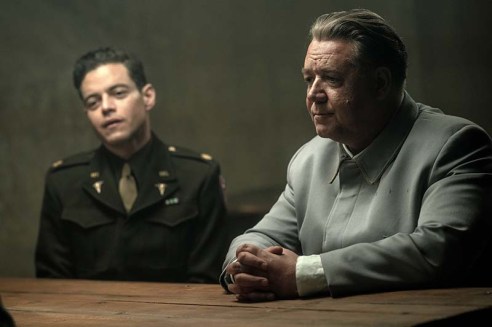
The movie has a few scenes displaying rather clever cinematography. In particular, the shot of Douglas Kelley when he tells his first lie to Göring. Half of Kelly’s face is literally and metaphorically bathed in shadow. However, the scripting at times attempts pathos but falls flat. There is also some messy exegesis. For example, when Kelly finds out he is to look after Göring, he clearly knows who he is; yet, a minute later, he asks for an explanation of who Göring is, as the plot clumsily brings the audience up to speed on this infamous historical figure.
The central motif of the film is the use of magic or, more precisely, sleight-of-hand trickery. Douglas performs a variety of these tricks throughout the movie, and then Göring himself performs his own metaphorical disappearing act via the use of (spoiler alert) carefully concealed cyanide.
One wonders if the scriptwriters took a leaf out of legendary BBC documentary maker Adam Curtis’ 1995 series, The Living Dead, which explored how governments construct narratives to maintain power, and sought to do this by examining the Nuremberg trials. In that series, Curtis contended that the allies “tried to perform a magic trick” with the Nuremberg trials. The trick was to create a meta-narrative of “the good [and] just war”. In doing this, they sought to erase the horrors and crimes of war itself, despite the ugly lived truth of their own soldiers’ experiences. These truths being that, ultimately, all wars are cruel and chaotic affairs, and therefore beyond simple narratives. Also, that fascist tendencies reside in all peoples in all countries and that they are particularly driven by those seeking power at all costs.

The most interesting scenes in Nuremberg are the conversations between Göring and Kelly which, in a way, mirror what the court case was meant to achieve: an examination into the many questions people had at the time, as well as uncovering the truth about the war and the heinous acts committed by the Germans. Göring sees no difference between the atomic bombs dropped on Japan and the American bombing of Nuremberg into the ground, while Kelley thought them not to be on par with Germany’s Jewish genocide. Most tellingly, the conversations get to the nub of the question of why people followed Hitler – a failed art student in the first place. The answer from Göring is perhaps the film’s true message. Hitler promised to return Germany to its glorious past, which is an eerie mirror for the contemporary ‘Make America Great Again’ movement and its demagogue, Donald Trump. Leaving one to wonder whether those who do not remember the past (because they have airbrushed part of it) will be condemned to repeat it in their own backyard.
The film concludes with the real-life tragedy of Douglas himself, who witnessed all this unfolding in real time and saw the risk it posed to the future of humanity itself: a truth that ate away at him until he could stand it no more, hence repeating Göring’s trick himself.
‘Nuremberg’ is in cinemas from Thursday 4 December.
Lurker: a film in which fan adoration turns quickly into stalking and abuse



Arts Centre Melbourne to put on a show of shows: an exhibition that pays tribute to iconic Divas

Discover more from
Subscribe to get the latest posts sent to your email.
