
Documentary film ‘Orwell: 2+2=5’ is hopeful in its call to action but how much power can the people have when the Algorithm keeps morphing and authorities continue to control speech?
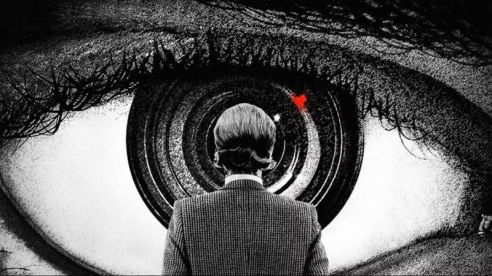
Orwell: 2+2=5 is not a positive film in the traditional, feel-good sense but it is deeply constructive and purposeful in its message. Rather than offering comfort or optimism, the documentary adopts a serious and often unsettling tone as it explores themes of propaganda, the manipulation of truth, and the dangers of authoritarian power, drawing heavily on George Orwell’s ideas from his book 1984 while incorporating excerpts from the many films that depicted his story.

The film challenges viewers to confront how language, media, and political narratives can be used to distort reality and control public thought, which gives the film a critical and cautionary character. Emotionally, it can feel heavy and sobering, as it exposes the fragility of truth and the ease with which societies can slide into systems that reward obedience over independent thinking – similar to how confronting the images of concentration camps are in recent film release Nuremberg.
However, despite this darkness, the documentary is positive in its underlying intent. It strongly affirms the value of truth, moral responsibility and critical awareness, urging audiences to question authority rather than accept information passively. But in reality, the ability to do so is getting more difficult as even the smallest, most peaceful protests are now seeing partakers imprisoned for simply having their say.

While the film’s purpose is not to depress the viewer, but to awaken them, even the subject of ‘wokeness’ is critiqued to a certain degree. While Orwell: 2+2=5 offers a kind of rhetoric, that it’s up to us to band together and fight despotism and totalitarian actions of governments and greedy corporations, it does little to equip us with the knowledge or skills on how to fight the biggest contemporary player of them all: the Algorithm.
It may not, after all, be the machines that end up controlling humankind, but the software planted in them, that can be altered at the will of the controllers of that software no matter what the narrative might be that they wish to push.
One minute Trump might be the villain, the next he’s the hero – depending on who is doing the presenting and where they are getting their assignments from.
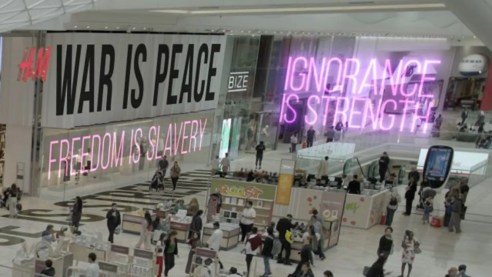
In the meantime, the pendulum will keep swinging on what is right and what is wrong (in politics and beyond), what is personal and what ought to be public (especially in reference to government surveillance), what is moral and what is immoral (see: pop culture), and what is truth and what is fiction. This dissonance and uncertainty is pretty much what Orwell wrote about decades ago. But in this so-called ‘information’ age, it’s getting more difficult to tell the differences – especially since mind manipulation is being used by corporations and governments right now into forcing you into that migraine so as you have to buy the panacea (and the migraine can come from just the fact that there is so much noise dished out to us online), or influencing you into a paranoid state by simply bringing up the subject of taxes the moment you express something online that goes against a government’s policy or intent.
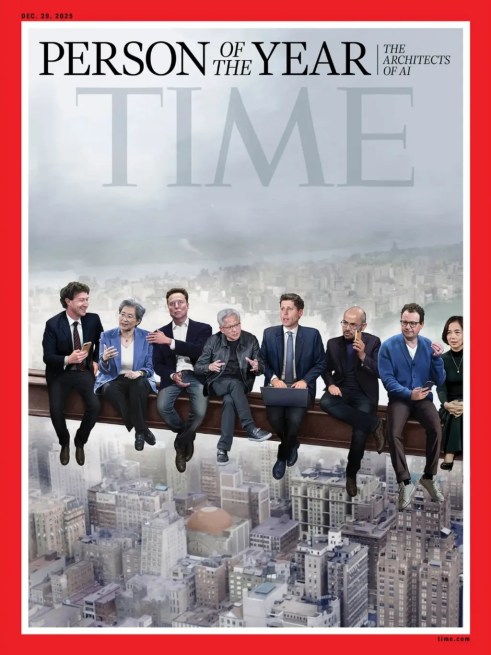
 The fact that individuals still have the power to think independently is one thing. That they don’t have the agency to express it nor influence others is an altogether other issue. And it’s an issue that defies all definitions of democracy – no matter how much the word might get bandied about in a digital world of clickbait, fake news, division online, and the corruptness of the powers that be. Just the fact that sudden rules come into place of who can view what online and when (eg: the under 16s social media ban in Australia) is enough to prove that authority will have their way no matter what the majority think or say. Meanwhile AI and its ‘architects’ are celebrated – this very week – making the cover of Time magazine as ‘Person of the Year’.
Yes, Orwell: 2+2=5 ultimately serves as a warning and call to action, but you can bet that the distribution of it – and critique of it, including this here little review – will be arbitrated by artificial intelligence, or at the very least the ambassadors of Big Tech somewhere along the line.
Rebellion can only go so far before it is forced to tow the line and, metaphorically speaking (or perhaps latently), end up bowing to the love for Big Brother.
‘Orwell: 2+2=5’ is in cinemas December 26, 2025 including Luna Palace Cinemas nationwide.
‘Nuremberg’ boasts a brilliant cast and some epic sets but occasionally falls flat on the dialogue
Lurker: a film in which fan adoration turns quickly into stalking and abuse

Author Riley Knight manages to put a quirky – and certainly odd – spin on death
Matchbox plenty: a mini tribute to Alfred Hitchcock classics in matchbook format

Discover more from
Subscribe to get the latest posts sent to your email.
