
The Psychology of Sales: How Design Influences Customer Perception and Buying Decisions
Customer often make decisions with limited information and even less time. Before they evaluate product performance, they interpret signals—visual, tactile, and contextual cues that shape perceived value and trust. Custom packaging is one of the most powerful of these signals. It doesn’t just protect a product; it frames how the product is understood.
This article breaks down how packaging design influences buying behavior, and how businesses can apply these principles deliberately.
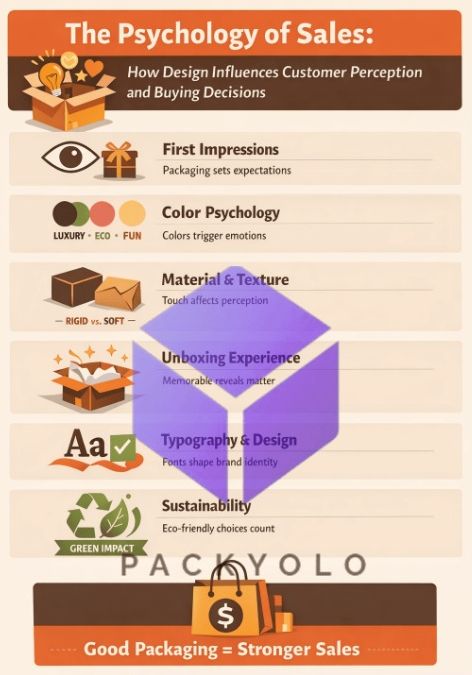
First Impressions Happen Before the Product
Customers rarely encounter a product in isolation. Whether on a retail shelf or arriving at a doorstep, the packaging is the first interaction point where brand awareness start.
Key insight:
- The brain forms judgments in milliseconds based on visual cues
- These judgments influence expectations of quality, price, and reliability
Implication for businesses:
- Packaging must align with the intended market position
- Premium product → structured, minimal, refined design
- Mass product → clarity, accessibility, bold messaging
Mismatch creates friction. A high-quality product in low-quality packaging lowers perceived value instantly.
Colour Psychology Drives Emotional Response
Colour is not decorative—it is functional. It influences mood, trust, and category recognition.
Practical applications:
- Black / Deep tones → luxury, exclusivity, authority
- White / Neutral palettes → simplicity, transparency, minimalism
- Green → sustainability, natural, health-oriented
- Bright colours → affordability, energy, youth appeal
What matters most:
- Consistency with brand identity
- Relevance to target audience
- Contrast and shelf visibility
Example:
Eco-conscious brands that use plastic-looking packaging with green colour schemes often fail because the visual promise contradicts the physical experience.
Material and Texture Influence Perceived Value
Customers don’t just see packaging—they feel it. This tactile experience directly impacts perceived quality.
Key variables:
- Weight → Heavier packaging often feels more premium
- Texture → Soft-touch, embossed, or matte finishes increase perceived sophistication
- Structure → Rigid boxes vs flexible packaging signal different value tiers
Business takeaway:
- Premium perception is often created through material choice, not just design
- Even subtle upgrades (e.g., matte lamination instead of gloss) can shift perception significantly
According to the founder of PackYolo, they have seen increase perceived value by 25–40% just by improving material quality and texture of the custom packaging of their clients.
The Unboxing Experience Extends the Sale
The sale doesn’t end at checkout. For e-commerce especially, the unboxing moment is part of the product experience.
Why it matters:
- It reinforces (or contradicts) expectations set during purchase
- It increases the likelihood of:
- Repeat purchases
- Social sharing
- Word-of-mouth referrals
Elements that enhance unboxing:
- Clean, intentional opening sequence
- Protective but aesthetic internal structure
- Inserts (thank-you cards, brand story, instructions)
- Minimal clutter
Important:
Overdesign can backfire. Complexity should never reduce usability.
Typography and Layout Signal Professionalism
Typography communicates more than text—it conveys credibility and positioning.
Key principles:
- Readable fonts build trust
- Overly decorative fonts reduce clarity and professionalism
- Spacing and alignment impact perceived organization
Common mistakes:
- Too many font styles
- Poor hierarchy (customer doesn’t know what to read first)
- Inconsistent branding across packaging elements
What works:
- Clear visual hierarchy
- Consistent typography across all brand touchpoints
- Strategic use of whitespace
Well-structured packaging reduces cognitive load and makes decision-making easier.
Sustainability is Now a Psychological Trigger
Sustainability has moved from a “nice-to-have” to a decision-making factor.
What customers evaluate:
- Material type (recyclable, biodegradable)
- Excess packaging
- Transparency in labeling
Important nuance:
- Customers respond to authentic sustainability, not just claims
- Visual cues must match reality (e.g., kraft paper, minimal ink, simple structures)
Business impact:
- Sustainable packaging can:
- Increase brand trust
- Justify premium pricing
- Improve customer loyalty
However, false signaling (greenwashing) damages credibility faster than having no sustainability angle at all.
Real-World Patterns That Work
Across industries, successful brands follow consistent packaging psychology principles:
Premium brands:
- Minimal text
- High-quality materials
- Structured, clean layouts
Direct-to-consumer (DTC) brands:
- Personalized touches
- Memorable unboxing
- Strong visual identity
Retail-focused brands:
- High contrast for visibility
- Clear messaging
- Functional packaging for stacking and display
The specifics vary, but the underlying strategy remains the same: reduce friction, reinforce value, and align expectations.
Practical Takeaways for Businesses
To apply packaging psychology effectively:
-
Define your positioning clearly
- Premium, affordable, eco-friendly, or innovative
- Packaging must reflect this consistently
-
Design for perception, not preference
- What looks good internally may not work externally
- Validate against customer expectations
-
Prioritize clarity over creativity
- Customers should understand the product within seconds
-
Invest in materials strategically
- Small upgrades can create large perception shifts
-
Align packaging with the full customer journey
- From first impression to unboxing
-
Avoid overcomplication
- Simplicity increases usability and trust
Final Thought
Customers don’t evaluate products in a vacuum. They interpret signals, form assumptions, and make decisions quickly. Custom packaging is one of the few brand elements that influences visual, emotional, and physical perception simultaneously.
Businesses that treat packaging as a strategic asset—not just a cost—gain a measurable advantage in how their products are perceived, chosen, and remembered.
Discover more from
Subscribe to get the latest posts sent to your email.

Leave a Reply