
Damon Deteso: Insights on the Discovery of the Planetary-Mass Companion GJ 504b, the “Pink Planet”
Damon Deteso is a diagnostic radiologist based in Saratoga Springs, New York, who has practiced privately with Millennium Medical Imaging, PC, since 2004, holding staff positions at five area hospitals, including Saratoga Hospital. He earned his medical degree from the University of Massachusetts Medical School in Worcester and completed his cross-sectional imaging training at the University of California, San Francisco, and San Francisco General Hospital. Before pursuing medicine, he studied physics at Holy Cross University, where he was inducted into the Sigma Pi Sigma National Physics Honor Society, a background that informs his lasting interest in astronomy, one of his listed personal hobbies. He also spent three years as a medical advisor to Imagen Technologies, focusing on artificial intelligence interpretation of X-ray images, and has published research through the Radiologic Society of North America. His physics training and enthusiasm for astronomy provide useful context for his interest in developments such as the discovery of the planetary-mass companion GJ 504b.
The astronomy discovery of GJ 504b, often nicknamed the “pink planet,” represents one of the most visually striking and scientifically intriguing exoplanet findings of the past decade.
Located about 57 light-years away in the constellation Virgo, this distant planet has drawn attention for its unusual appearance in processed images and what it reveals about planetary formation, atmospheric composition, and the limits of current observational technology.
GJ 504b was first announced in 2013 by astronomers working with the Subaru Telescope in Hawaii, using the High Contrast Instrument for the Subaru Next Generation Adaptive Optics (HiCIAO) as part of the SEEDS survey, which aimed to directly image exoplanets around nearby stars. Astronomers were able to block out the overwhelming starlight and capture faint infrared emissions from the planet itself, allowing them to detect a small, faint companion orbiting the star GJ 504.
At the time of its discovery, GJ 504b was considered unusual because it combined different characteristics. It is a gas giant with a mass several times that of Jupiter, orbiting its star at a relatively large distance (estimated at roughly 43 astronomical units, which is more than the distance between Pluto and the Sun in our solar system). This wide orbit raised questions about how such a massive planet could form so far from its star.
Two main theories emerged: Either it formed like Jupiter (through gradual core accretion and migrated outward), or it formed more like a small star (through gravitational collapse in a disk of gas and dust).

One of the most debated aspects of GJ 504b has been its age, which directly affects estimates of its mass and formation history. Initial studies suggested that the host star system was relatively young, around 160 million years old. Under that assumption, GJ 504b appeared to be a relatively low-mass exoplanet with a relatively cool temperature compared to many directly imaged gas giants.
However, later studies proposed that the star might be significantly older, possibly several billion years old. If the system is older, then GJ 504b would be much more massive and hotter than originally thought, potentially approaching the boundary between large planets and brown dwarfs.
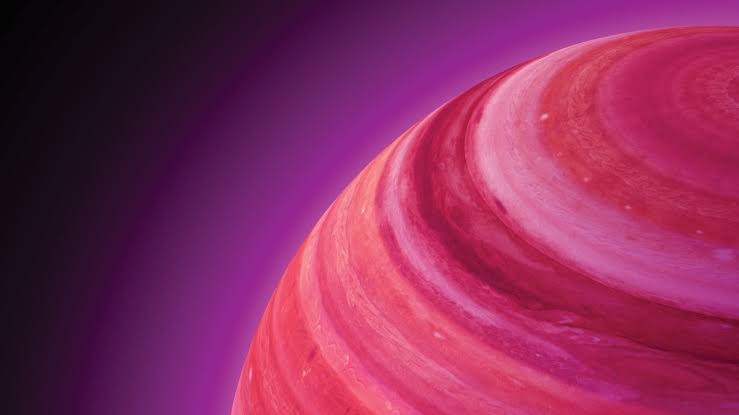
The “pink” appearance associated with GJ 504b comes from infrared imaging techniques that assign visible colors to wavelengths of light that the human eye cannot see. In many published images, shorter infrared wavelengths are mapped to blue and longer wavelengths to red, with intermediate processing producing a magenta or pinkish tone.
Additionally, atmospheric modeling suggests that the planet may contain complex cloud structures and chemical compounds such as methane and other hydrocarbons, which can influence how light is absorbed and scattered. In recent years, space-based observatories and advanced ground-based instruments have allowed researchers to reanalyze its spectrum and better estimate its temperature, atmospheric pressure, and chemical makeup.
While earlier interpretations emphasized its unusually cool temperature and youthful nature, more recent studies have leaned toward a more complex picture in which the planet may be older and larger than initially believed.
The broader significance of GJ 504b lies in its role as a benchmark for studying directly imaged exoplanets. Unlike planets detected through indirect methods such as transits or radial velocity, directly imaged planets like this one allow astronomers to study emitted or reflected light more directly. This makes it possible to analyze atmospheric composition in greater detail, particularly in the infrared spectrum.
As a result, GJ 504b has contributed to improving models of gas giant atmospheres, especially those involving cloud formation, heat distribution, and chemical reactions under varying temperatures and pressures.
About Damon Deteso
Damon Deteso, M.D., is a diagnostic radiologist practicing at Millennium Medical Imaging, PC, in Saratoga Springs, New York, since 2004, with staff appointments at five regional hospitals. He holds a medical degree from the University of Massachusetts Medical School and completed imaging training at the University of California, San Francisco. A Holy Cross University physics graduate, he later advised Imagen Technologies on AI-based X-ray interpretation and has contributed research to the Radiologic Society of North America. Outside medicine, his interests include astronomy, skiing, and music.
Discover more from
Subscribe to get the latest posts sent to your email.

Leave a Reply