
Steve Kilbey of The Church says he prefers to be wired for sound but he’s not too keen on this thing called ‘electromagnetic pollution’ (apparently you can get it from an iPhone!)
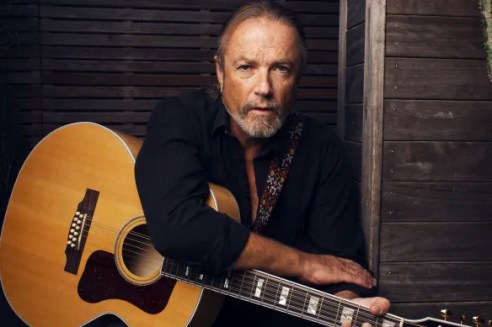
Formed in Sydney in 1980, The Church are one of Australia’s most enduring and influential alternative rock bands, known for their lush, atmospheric soundscapes and poetic lyricism.
Fronted by bassist, vocalist and primary songwriter Steve Kilbey, The Church have carved out a distinctive niche in the rock landscape, blending jangly guitars, dreamlike textures, and introspective themes into a style that defies simple pigeonholing.
The band first gained national attention with their debut album Of Skins and Heart (1981) that featured the breakout single The Unguarded Moment. However, it was their 1988 album Starfish that propelled them to international recognition. The record’s shimmering, hypnotic single Under The Milky Way became a global hit, often cited as one of the most iconic songs in Australian music history. The song’s haunting melodies and celestial atmosphere exemplified the band’s ability to merge pop accessibility with ethereal, psychedelic undertones.
Despite lineup changes and shifts in the musical landscape, the band has maintained a consistent artistic vision and continue to perform to this day.
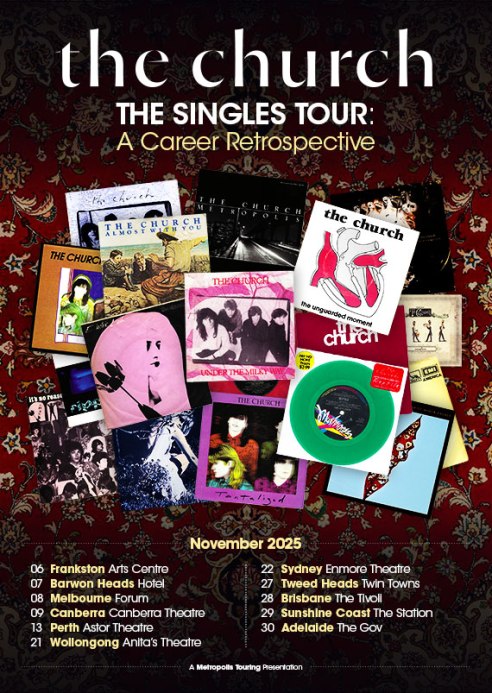
This coming weekend, they will be performing at The Enmore Theatre in Sydney (Saturday 22 November), then return to The Forum in Melbourne on Sunday 14 December and then again on Wednesday 4 February (getting ahead of ourselves here).
Cream recently chatted with frontman and veteran musician Steve Kilbey about playing live back in the day compared to now, and this fascinating thing called ‘electromagnetic pollution’ that he might just have the perfect solution for.
Interview by Antonino Tati
“Back in the day everybody got wasted every night, pre-show, post-show, on stage, off stage.”
Hi Steve. I was going through some Church music videos on YouTube, only to realise there are so many clips out there, too, from you as a solo artist.
Yeah, I think outside The Church I’ve made, like, 50 albums with various collaborations and everything else. I’ve made about nine albums with Martin Kennedy alone, who was in a band called All India Radio. I like to collaborate with people in different ways. In the case with Martin, he writes all the music and I just sing, so basically I write the words and melody.
Nice. I also caught your lovely collaboration with Kate Ceberano and Sean Sennett. I love that track ‘Monument City Lights, 1973’.
I only wrote the lyrics, but I did do a bit of backup singing.
How are you finding the modern ways of recording and delivery of music? Do you work from a computer or software at all, or is it all analogue style in the studio?
Well, it’s a lot more efficient for you these days with, with access to digital technology. And I love recording from home. With new technology, there’s always a getting-used-to. I remember I got really frustrated with one of the very first domestic four-track machines in 1977. But you get used to the medium in any given period. Then, about 10 years ago I discovered (audio creation software) Logic Pro and I bought all these plugins and you had to do an update and that didn’t work. So it can get frustrating. For an old guy, I don’t want to have to relearn something all the time. So most of the time I just want to jump in the studio and do it. And I loved being my own engineer when there is a mixing desk. Also, there’s this thing called electromagnetic pollution…
You mean exposure to electromagnetic waves, like, from wireless devices and power lines?
Yes that. So it started doing my head in working with computers. I’m so sensitive to it. I went and saw a naturopath the other day and he went, ‘Man, your electromagnetic pollution is off the dial’.
Does that sort of EM pollution come from things like electric guitars and synths – because you’ve been around those for decades on stage and in the studio.
No, nothing from bass guitars and other instruments. I’m talking about the internet and iPhone.
Wow. So if these waves exist, how do we counteract them?
The other day I bought this little device that gives off healing frequencies, and it is like, oh, whoa! You know, you can dial up a frequency, too.
It helps heal the negative vibrations?
Yep. And I have tried many things off the internet. Like, buy this and buy that. This will make your hair grow and this will make your penis grow and this will make your heart beat and all that I found is that nothing really works. And then I found this device, and it came with a grounding mat.
How do you operate it?
It just plugs into the earth through your wall, and you don’t turn the power on. It just connects you to the earth. I’ve slept on top of this map for two nights running and I’ve woken up feeling really good. When I get in the sea, the water washes it all off too, but I’ve just become, I’ve just become hypersensitive to all this stuff.
So a grounding mat, I’m going to be Googling that after this interview.
It’s just a sort of sheet of rubber and it’s got this little lead and it plugs into the earth socket without switching that on and it’s still giving you grounding connection to the earth. It’s quite literal. You’re grounded, you’re literally earthed.
I’m liking what I’m hearing. Now, to the band everyone knows rather well, The Church. The band is on a limited tour at the moment, playing Melbourne and Sydney this month. I read that it’s a live singles retrospective of sorts?
Yep!
“I have tried many things off the internet. Like, buy this and buy that. This will make your hair grow and this will make your penis grow and this will make your heart beat and all that I found is that nothing really works.”
Whose idea was it to do such a tour?
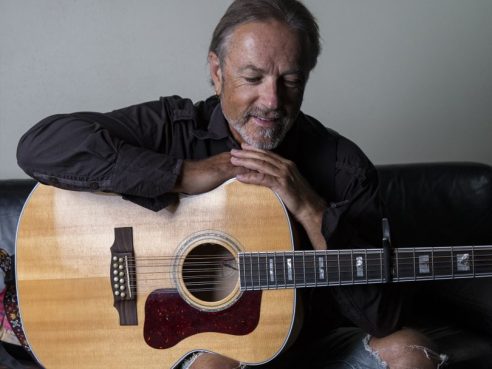
The band members I currently play with are all 15 years younger than me and they were teenage fans of The Church so they wanted to play the singles. It’s me who maybe didn’t want to do it but with a little coaxing…
So, working with the younger musicians is good?
Absolutely. They treat the guitar parts very reverently, sometimes more reverently than the original guys. And they don’t get drunk or take drugs and there’s no competition. With the old band, things used to get sloppy and lazy and argumentative.

Steve Kilbey staying centred with the help of his newer bandmates in The Church.
The modern music scene is certainly very different to what it was back in the day.
When I started off in 1980, you know, the roadies were wild and the musicians were wild and the audience was wild and the gigs were wild. Even the managers were crazy guys. It was like the Wild West but it’s not like that any more. That said, the music delivery now is better.
Kudos to you for even having the energy to go on stage and play. I sometimes find it a pain just getting up and walking to the turntable to put a bit of vinyl on!
It’s incredible at this late stage of the game at 70 years old, but when I go on stage I want to deliver the best gig I possibly can and not make a mistake on the bass, not forget one single word, to get my pattern down really well.
I was going to ask how do you compare performing today to the 1980s, or even the ’90s.
Then, we would have turned up and, like, 60 people would be in our dressing room before the show, eating and drinking and taking all kinds of drugs, and offering all kinds of drugs. The band could be arguing. All of the girlfriends were in there, swanning around, lording it over everybody else. The girlfriends trying to keep other girls away from you, and the mates are all in there and everybody’s everywhere. And the last thing on your mind is the fact of, hey, we’re about to go on at this theatre and play this show. Suddenly you’re on stage and, thankfully, the two guitarists we had then, Marty [Willson-Piper] and Peter [Koppes], were absolute geniuses.
I’m glad you all had such a good time. And after the show?
Then, after the show, even more people were coming in – all the music [industry] people, more friends, and they’re all staying and they’re all eating – well, some were eating – and all of the alcohol, and all of the drugs, and all of the laughter and all of the noise. It was like one chaotic party. So, you know, back in the day everybody got wasted every night, pre-show, post-show, on stage, off stage.
When I was a teenager, still in high school, I found The Church to be very much a grown-up ‘college’ type band. And then when I got to uni, everyone was listening to The Church. How did that credibility make you feel?
Really good, of course. I suppose we mostly got good reviews, and I think, especially in America, people thought we were sort of a thinking man’s band. There is this stupid part of rock’n’roll that I’ve never wanted to be a part of. I didn’t want to dumb things down. I didn’t want to sing stupid things. And I read, lots and lots and lots of books. I love words. I love words as much as I love music.
“I mean that sort of music transcends trends and time, really, and becomes almost classic in itself. I like to bring that to my music – a lot of ambiguity, some surrealism, rhyming schemes, alliteration and onomatopoetic words. So a verse could be, I’m doing this, I’m doing that. And then the chorus can turn into, she did that.”
To the point of writing poetry yourself, yes?
Yes. I’ve written a couple of books and I used to write a blog every day. I really thought rock’n’roll got interesting when Dylan started writing Mr. Tambourine Man instead of Blowing In The Wind, and was alluding to Shakespeare and Greek mythology. And when the Beatles started writing, you know, Strawberry Fields and Lucy In The Sky, instead of ‘She loves you, yeah, yeah, yeah’. When the lyrics became kind of poetic and they alluded to all kinds of things and took you to all manner of spaces. I mean that sort of music transcends trends and time, really, and becomes almost classic in itself. I like to bring that to my music – a lot of ambiguity, some surrealism, rhyming schemes, alliteration and onomatopoetic words. So a verse could be, I’m doing this, I’m doing that. And then the chorus can turn into, she did that.
And you feel you did all that in even The Church’s earlier recordings?
Sort of, although it took us a while to do whatever we liked, but we learned to do that. I think we came fully into our own and created a complete kind of world for the listener to escape into. I was very pleased with those records.
Why is it that songs like ‘Unguarded Moment’ and ‘Almost With You’ resonate as much with listeners today as they did when released 40 years ago?
Hmmm, I don’t have the answer to that, but I wish I did. If I did, I’d be a gazillionaire. I’d be knocking out so many songs.
I first heard those songs in my early teen years. I think in your teens you fall in love with stuff that you’ll be in love with forever.
I’m happy as long as someone’s out there still playing it. It might mean they’ll be wanting to go and see it [ie: Steve and the band performing live]. And when they hear that song – whether it’s Unguarded Moment or Almost With You, it just brings back memories – even if those memories were formed in some squat they were living in. With the little kitchen table, the TV on, the clothes they wore and, you know, the bong on the table, and all that.
There might still be a bong on the table, lol. Now, to possibly your most famous song, ‘Under The Milky Way’. That one to me is virtually religious. Cosmic, for sure.
Yes, compared to Milky Way, Unguarded Moment and Almost With You are like beer bar anthems [Laughs].
Craft beer bars, maybe. But I suppose you’ve performed and heard those songs hundreds of times. I think I heard ‘Under the Milky Way’ on Coles Radio the other day while I was shopping for groceries. What do you feel when you’re in, say, a supermarket and a song by The Church comes on?
Well, I know when the songs are played, they impact my daughters. I’ve got five daughters, and one of my daughters rang me up one night and said, ‘Dad, I’m standing in the bar with my boyfriend and, um, and you’re on the TV and you’ve got makeup on, and like this real hairdo, and you’re singing this song.’ And I said, is that making you all excited? Is it darling? And she said, ‘Nah, but it is making my boyfriend excited.’
Win-win, really. I think what might have shocked your daughter most is that the look you had was somewhat ahead of its time; rather hipster.
I don’t know. I don’t know if it [was a look that] appeals to the youngsters.
So long as the songs do, eh?
Absolutely.
The Church next play The Enmore Theatre in Sydney on Saturday 22 November, then return to The Forum in Melbourne on Sunday 14 December, 2025 and then again on Wednesday 4 February, 2026. Tickets are available through Ticketek. One to definitely put into the social calendar.
From the Vault: an interview with Suede frontman Brett Anderson, new album ‘Antidepressants’ out now

https://www.youtube.com/watch?v=Z6svsgxZLNU



Discover more from
Subscribe to get the latest posts sent to your email.

Leave a Reply