
Everything Everywhere All at Once: Why Madonna’s Fitbit stats must be off the charts, and will the oversaturation for new album ‘Confessions II’ pay off?
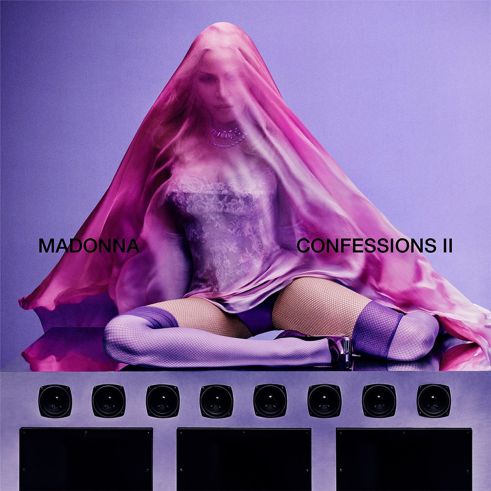
Having grown up a good Catholic boy, and being an avid listener of pop music as a kid, I was infatuated with music artist Madonna from the moment I’d first heard her name. It was a balmy Perth night in 1983 and I was returning home from work with my Dad. I just wanted to wash the work day from me and sit down to a marathon of music videos kindly recorded for me by my sister Melina. “You’re going to love this new singer named Madonna,” insisted Melina. “Her look. Her sound.” She was right, it was love at first sight. Love and awe. I told my good sis that if Madonna was her real name, this artist was going to be massively popular, as if I knew by some kind of vicarious enlightenment.
There was something wonderfully outrageous about a music artist with that name entering the relatively unholy music scene – particularly exciting to this queer Catholic kid.
There certainly was, and still is, something magical about the single moniker. And don’t get me started with the irony and paradox of it all – a not-so-virginal looking Madonna (she wore rubber bracelets up to her elbow) dancing confidently in front of the camera, delivering too-cool moves in the clip for Holiday. In short, Madonna would go on to chip away at the holier-than-thou hypocrisy of the Catholic Church, while making religion a music-sexy thing. I sensed all this the moment my sister said her name.
Still not out myself at 13 – in fact I never thought of sex at school and was a virgin until I turned 19 – I knew that there was something different about me. Something… queer. I instantly sensed in Madonna – with her forthright attitude and androgynous aesthetic (those bushy eyebrows of 1983/4, I still love) – that a certain revolution was on its way. And that revolution would definitely be televised.
Rock’n’roll is one of the quickest ways to get into the corridors of power, greed and corruption and to attempt to disrupt them from within. To try and undo some of the megalomania; put sexism and homophobia in their place. I instantly got the impression that Madonna was always going to get past security.
The hype around the artist – who would go on to release no less than four singles in Australia in the span of half a year (Holiday, Lucky Star, Burning Up, and Borderline) – was kinda akin to the campaigning that is executed by today’s pop starlings (some releasing just about every song from their albums as singles). But Madonna’s was more of an impressive brand of marketing due to the fact that all her promotion was carried out through analogue media and organic means: interviews and advertising, sometimes literally having to spruik her songs to DJs in person. In the ’80s, getting a record out there to the public meant doing the hard yards – promoting it through slower, traditional media like television and radio, and of course live performance Occasionally, it also meant sleeping with a DJ or two. (And given their general charm and cuteness, why not?). Whatever which way was adopted, Madonna was indeed a leader in the field of music self-promotion – some might say a genius. Or a despot, depending on whose telling the story, and whose toes she might have “stepped on” along the way to superstardom (I’m actually assuming it would have been more of a dance-type glide over their toes).
Always at the fore of reinvention, this ever-shining supernova would go on to unleash as many new looks and sounds as she did new albums. Scrap that. She pretty much changed her look with every music video. You could say Madonna was the inventor of the ‘era’ concept in pop music – if only invention offered leniency to the cunning art of cut-and-pastiche in an oh-so intertextual world of pop. But I’ve always loved a bit of pop doucapage myself.
Madonna once said in Cream, in 2006 (and her candidness on the subject was quite refreshing): “Movies, music, art exhibits, books – I have an insatiable hunger and curiosity to find out about new things that are going on. Inevitably those things find their way into my work, and I think that’s what we all do as artists and creative people – we all plagiarise each other.” Critics that say she’s copied artistry in her rise to the top, take note. She knows. She also knows how to make it more enticing, whether it’s making the Marilyn schtick sassier, turning an underground trans ball routine into a global phenomenon, or daring to bring once-were-dichotomous cultures, creeds, genders and sexualities onto fairer (and funner) meeting ground: the dance floor.
Just as today’s mini music icons (history will show the likes of Sabrina Carpenter and Adriana Grande to be mere Pop! Vinyl in contrast to Madonna’s bronze solid presence in music’s hall of fame) have pretty much all admitted to having been inspired by the Queen of Reinvention (Dua, Cardi, Miley, Bey, Charli, et al), Madonna herself is evidently taking cues from them in keeping on top of modern music marketing methods. In fact, you might say she’s gone over the top in the ultra-promotion of her newest album Confessions II.
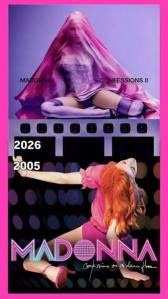
If you’ve scrolled through your phone even for a minute in the past month, you’d have come across a brief critique or stack of j-pegs relating to the new LP, a sequel of sorts to her successful record of 2005, Confessions On A Dance Floor. The official release of the album was June 3rd, but visuals promoting it have seemingly been everywhere over the past few months. This week, every second post I’ve seen on Facebook has referenced the record, and I only follow three Madonna-related Facebook pages. She – and the title of the album – are literally all over the shop on social media, reaching audiences in the millions every minute of the day. Madonna has also kept busy trekking the globe it seems. One day she’s doing promotions and podcasts all across the US, the next she’s in a UK setting, showing what’s on her coffee table to Vogue readers, or camping it up with Graham Norton and Kylie Minogue and doing it for the gays. That rumoured Kylie collab was the one I was truly waiting for. A song which would have had the most production time spent on, but perhaps just not ready, or has been scrapped for a rainy day. The latter would be a dumb option. Curating and culling songs, creating videos for them, doing interviews and live performances – in short, Madonna has been real busy.
In fact, if I were an Oura ring on Madonna’s finger right now, or a Fitbit on her wrist, I reckon my steps and other vital stats would be going through the roof.
Borrowing the slapped-together-in-a-couple-of-minutes aesthetic of Charli XCX’s brat era, the album’s artwork – in its tens of guises – looks like it could have come off a photocopy machine at Officeworks (wait, do they still actually have photocopiers?). Besides the cool album art at the top of this story – which was the first iteration of cover art we saw – there’ve been hundreds strewn across the web, some official, many mocked up by super-fans – and it’s only making us all very confused. Which album variation has the greatest number of tracks? Which LP has the best tracks? Are the tracks all very good or meh? I’ve heard most of them, of the standard version of the album, and so far the real standout is Danceteria – a love letter from Madonna to the friends and fun times they would have on the club circuit in New York when she was just starting to get into her groove. I’m guessing the lyrics to this song were being penned while the idea of a Madonna biopic was being bandied about. That particular production was scrapped, so why not use it for an album – one dedicated to the dance floor? Great idea. Good song.
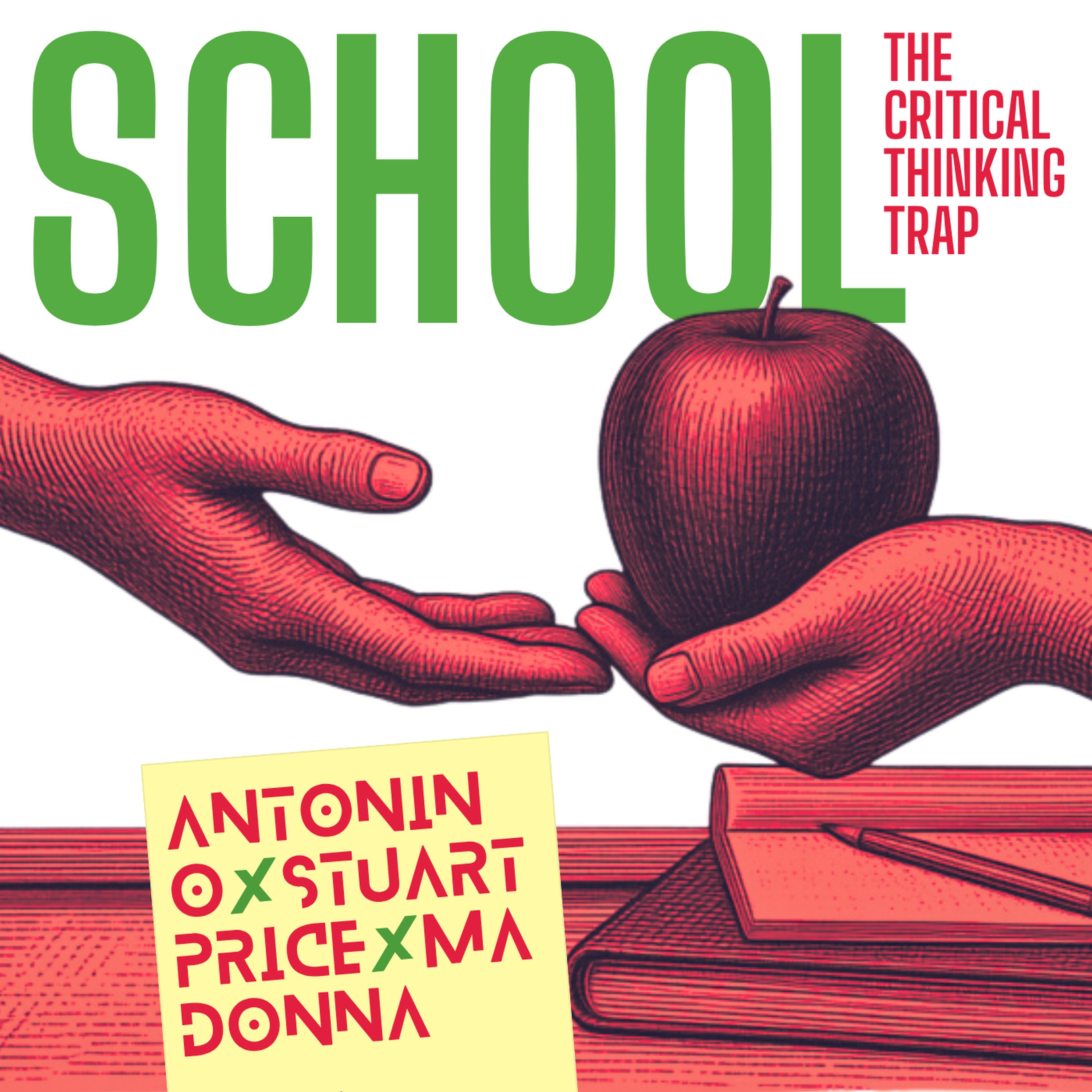
And I love, love, love a song called School with its wonderfully warped electronic experimentation and daring tinges of darkness from which the sonics impressively manage to climb out of. Stuart Price’s music production prowess is so cunning, you can practically hear the flutter and thump of text books in some remixes. Loving the unabashed use of audio drag, too, to quote a term once taught to Cream by electro pioneer Laurie Anderson – and for which Madonna’s sexually ambiguous repertoire and androgynous vocals are perfectly suited to.*
Here is a reproduction in all good faith and by yours truly of Price’s A-grade Extended Detention mix that I decided to subtitle ‘The Critical Thinking Trap’.
Also high on my like-list is The Test, a duet the iconic one does with Lola Leon, aka Lourdes, Madonna’s daughter. It’s a beautiful, honest song about the relationship between mother and daughter, sometimes on show under bright limelight, more often at the dinner table or maybe the bathroom vanity. In fact, there’s a certain dark lightness to the song – something chiaroscuro about it – right from the moment Lourdes’ soft cry ‘Momma’ makes its way out of the electronic software.
This is Mother/daughter stuff. But it is that mother. To balance the deepness of the song, there are lovely metaphors and a nice ‘groovy’ vibe. Indeed, come chorus time there’s a kind of ’60s love feel stemming from the song. As for Lourdes’ talent. The Girl. Can. Sing. And when the matriarch and her beloved offspring sing together, it really is quite magical. And then there’s Fragile with its brave expression of the uncertainty of mortality.
When things get edgy and electronic and experimental on Confessions II, the record shines like quality music should. But many of the other tracks on this record, particularly on the first half of it – the ones competing for contemporary relatability – sound a bit same-ol’, same-ol’. Several even adopt the same backbeat, practically. As for Madonna’s vocals, there’s a lot of Autotune going on in the clubby tracks, but then the kids out there are all over the shop, popping the pills and whatnot so they won’t really notice. When the artist does pull away from digital attraction and goes rawer in the vocal department, like on the aforementioned duet with Lourdes, you’re nodding your head up and down and then side to side, as if to say, there’s something really good here if only such social media virality and Spotify viability hadn’taken up so much of the Board’s time (and dampened some of the proceedings).
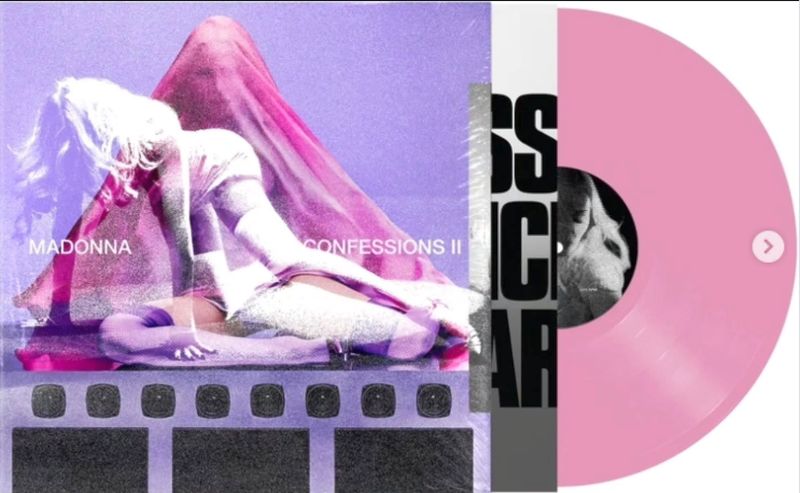
A 16-track Deluxe 2LP version of the new Madonna album ‘Confessions II’, which is also available on standard 12-track vinyl, on picture disc, CD, and even cassette.
In all honesty, I feel Confessions II could have been a stronger, more consolidated album. To me, parts of it seem a little rushed in the making. There was no real reason to set a deadline sooner than later (despite having re-signed on with Warner Music, Madonna is still very much her own boss), and we didn’t have to see and hear so many scattered fragments of the LP in the lead-up to its release. What might have been the wiser move would have been for Madonna to keep away from social media for a bit, and focus instead on more focused studio time, more interesting song structures (like we hear on the second half of the LP), and even more awe-inspiring themes. There are so many mini highlights on this record that could have been extrapolated on: the odd bit of strings or piano rounding out some of the dance tracks, for example. More, more! Heck, bring in a symphony orchestra next time. And don’t tease us with occasional dips into trip-hop tributing. Get Massive Attack on the phone, stat.
Hopefully, the remixes will compensate for the colour-by-numbers tracks on Confessions II, the ones that have been given the bigger push so far. And let’s hope remixes will be coming from official producers and bedroom boffins alike, if only the masses could turn their attention away from their Apple playlists for a moment and in the direction of excellent platforms like Soundcloud and Mixcloud.
It might even be a good idea if Madonna and Stuart Price were to give select music mixers the stems of some of the new music, to see what alternative versions they’d make of the songs. I know I’d love to send a couple of the tracks into bold and sassy electronic directions.
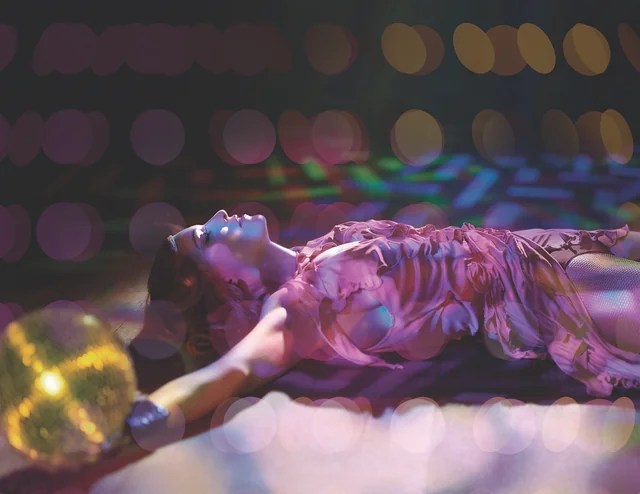
But back to all the hype. Listening parties for Confessions II have been organised in pretty much every country. Impromptu live performances have taken place (from dingy nightclubs to the heart of Times Square). Forums have debated the album’s content and look. Celebrities have been roped in to cameo in music videos. And final-days countdowns have been rotating to keep up the marketing momentum. So much so, that if this record doesn’t achieve at least half a million sales globally, the income probably won’t cover the gazillions spent on marketing.
In 2026, a “successful” album is no longer judged by pure record sales but by equivalent units (a combination of pure sales and streaming). Achieving gold status (500,000 equivalent units) or Platinum (1,000,000 equivalent units) status remains the industry standard for mainstream commercial success – in the United States, at least. These figures don’t look too out of reach for Confessions II but methinks Madonna is after a heftier sales figure here. Indeed, forget the sales – for she doesn’t really need the money – what this icon of icons is clearly after is the number one status. A trip to the top of the charts again, like things used to be. Showing fans, followers and quick-to-critique media bitches (like me, I guess) that relevance is still in the artist’s reach.
In the end, what will really speak volumes is the music itself. Will the album be generally viewed and heard as good (perhaps even brilliant) or in retrospect, will the full project look and sound like a blight on Madonna’s otherwise remarkable discography?
Although not as much of a trailblazer in the promotion of this release as she has proven to be in the countdown to previous releases – again, I reference Charli’s messy brat aesthetic-alike and ubiquitous online presence here – Madonna has still delivered another first, and that’s even before Confessions II was officially released. She has shown the world in real time what insistent marketing in the modern media scape can do for a record. It can either hook the masses in, or send them away in droves due to the oversaturation. Whether all the SEO tricks in the world will help sell a record or not… well, the tallying on this one has only just begun.
While Confessions II is cohesive to some degree – purely for the fact that a lot of the songs sound similar on the first half of the album, and that there’s consistent electronic experimentation on the second half, it doesn’t fully gel for me. Here’s hoping, again, that the remixes will be aplenty. Producer Stuart Price is a dab hand at getting super sonics and trippy, clubby effects into his productions, and I’m sure he can go further with the audio immersion thing.
As for the promotional music videos, please, please, please, no more green laser lights darting out of naughty bits. The kids are watching this.
Confessions II is out now in various formats with pricing starting at AUD4.99 for the 12-track digital download.
* Paragraph edited September 10, 2026.
In the company of muses and gods: an interview with rock poet Patti Smith from the Cream archives

Curating the Ultimate Luxury Weekend Getaway in the Heart of Sydney
Hands in the air for a ‘Romy and Michele’ movie sequel is finally in production
Discover more from
Subscribe to get the latest posts sent to your email.

Leave a Reply