
The Evolution of ‘Star Wars’ Gaming: from the Arcade to the Couch
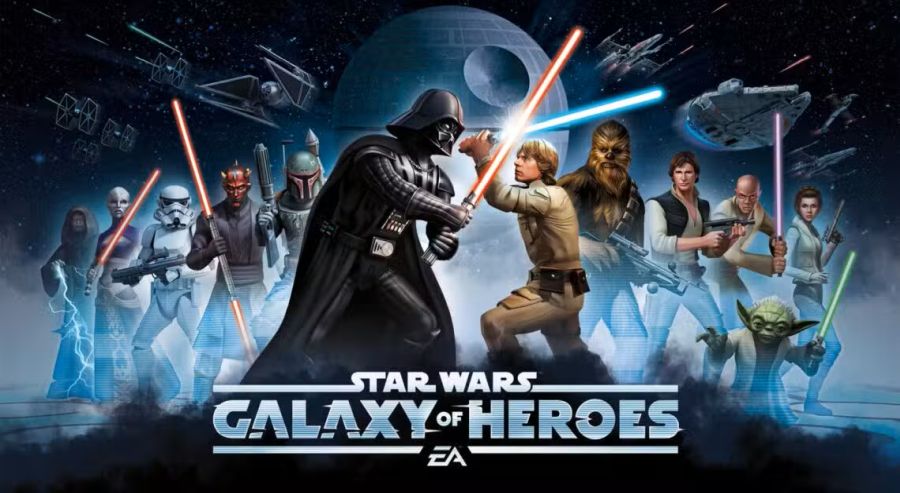
The arcade was never only a screen. It was a place, a machine and, usually, somebody waiting behind you for their turn. Cream contributor Søren Kamper takes a deep dive on how a classic game series such as ‘Star Wars’ fits into the picture.
The movies themselves have always made Star Wars feel enormous. The games did something slightly more mischievous: they made it shareable. A cinema could fill a room with a galaxy, certainly, but everyone still sat facing the same direction. A videogame changed the arrangement. Suddenly somebody had the controls, somebody else was shouting advice, and a third person was insisting they could do the Death Star trench run better despite considerable evidence to the contrary.
Across more than four decades of Star Wars games, the technology has changed beyond recognition. Cabinets became cartridges, cartridges became discs, discs became downloads, and the family television eventually acquired enough cables to qualify as a minor engineering project. What remained was the social promise: Star Wars was no longer only something to watch together. It was something to perform, compete over and occasionally blame on the other controller.
The galaxy arrives at the arcade
Atari’s 1983 Star Wars arcade game understood spectacle before anyone needed the phrase “immersive experience”. It used colour vector graphics, digitised voices from the films and a flight-yoke controller to turn the attack on the Death Star into a physical performance. Atari says more than 12,000 cabinets were sold, and the game’s design made the point instantly: you were not merely looking at Luke Skywalker’s cockpit. Your hands were on the controls.
That distinction mattered because an arcade machine existed in public. It flashed, barked familiar dialogue and dared passing players to stop. The person actually playing was only part of the audience. Friends watched over shoulders. Strangers noticed a high score. Someone inevitably waited nearby with the particular expression of a person who believed the current pilot was wasting perfectly good credits.
That is still part of what makes arcade culture different from at-home gaming: the machine creates a social space around the act of play. In the arcade, Star Wars was theatrical. The cabinet, the controller, the noise and the people around it were all part of the show.
Then somebody put the galaxy next to the television
Home versions inevitably lost some of that theatre. A plastic controller could not quite reproduce the feeling of climbing into a dedicated cabinet, and a domestic television rarely had the visual authority of a glowing machine surrounded by the noise of an arcade. But the move home did not make Star Wars gaming less social. It simply changed the size of the crowd.
The living room produced its own rituals: passing the controller after a life was lost, arguing over whose turn was next, watching an older sibling discover a shortcut and then pretending you had known about it all along. Games that were technically single-player could still be intensely communal because there was usually somebody else in the room. The sofa became a tiny grandstand.
That is why places devoted to old hardware still feel strangely alive. A retro gaming museum filled with playable consoles is not interesting merely because the machines are old. It restores the physical context: standing next to somebody, swapping places and remembering that videogames once occupied very specific pieces of furniture.
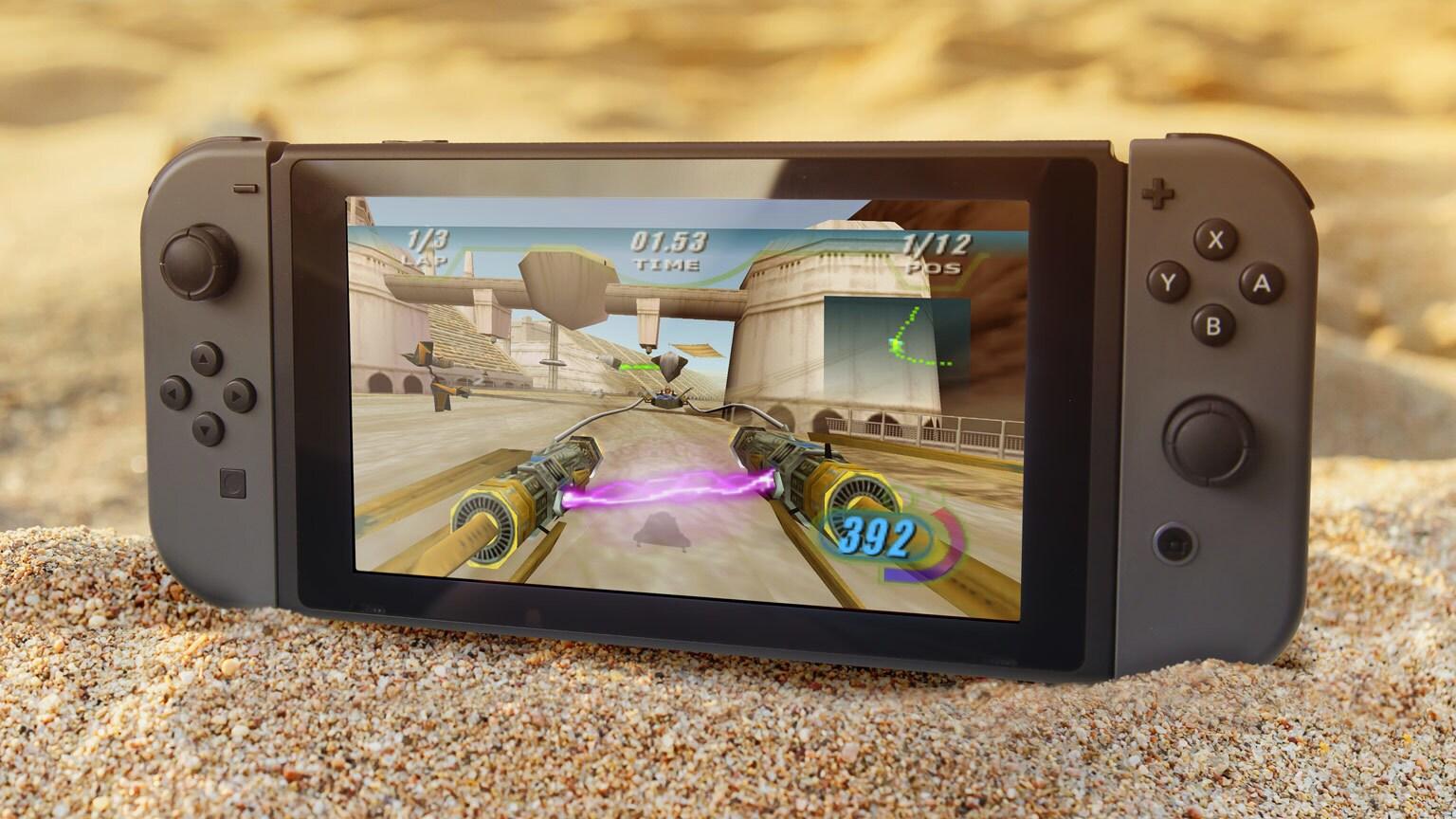
Episode I: Racer eventually returned on modern hardware with split-screen intact: two engines, one television, and at least one person blaming Sebulba. Image: Lucasfilm/Aspyr via StarWars.com.
Split-screen turns Star Wars into a sporting event
By the late 1990s, local multiplayer made the social part explicit. Star Wars Episode I: Racer on Nintendo 64 let two players race side by side on a split screen. This was not cooperation. It was something more honest: friendship placed under unnecessary stress at several hundred kilometres per hour.
Podracing was perfect for it. The film sequence already behaved like a sporting event, complete with crowds, commentators, dangerous machinery and a child operating equipment that would cause several government inquiries today. The game took that energy home. One person could be Anakin, another Sebulba, and the television stopped being a window into Star Wars and became a shared arena.
The important shift was not simply technical. Star Wars had moved from public spectatorship in the arcade to intimate competition in the home. The audience was smaller, but everybody in front of the screen had a stake in what happened.
 LEGO Star Wars made cooperation part of the joke: family-friendly, forgiving and built for two people on the same screen. Image: LucasArts/Lucasfilm/Traveller’s Tales via Steam.
LEGO discovers the secret weapon: another player
Then LEGO Star Wars arrived and found perhaps the cleanest version of the idea. Its local co-op did not ask two players to be equally skilled, equally serious or even equally interested in following the objective. One person could solve the puzzle while the other wandered off, smashed scenery and collected studs with the focused determination of a tiny plastic accountant.
That looseness was the genius of it. Star Wars could be shared between siblings, parents and children without the game demanding that everyone approach it in the same way. A second player could drop in, help, make a mess and leave again. The fiction was familiar enough that explanation was rarely necessary. “You’re Obi-Wan, I’m Anakin” did most of the administrative work.
It also changed the tone of failure. Losing alone can be irritating. Losing in LEGO Star Wars because your co-op partner has once again fallen off the same ledge is a story. Sometimes it is a story told loudly. Often for years.
From the couch to the network
The Battlefront games expanded the same impulse. The fantasy was no longer only about being Luke, Han or Vader. A player could be one soldier among many, occupying a battlefield that only made sense because other people were there too. Later entries pushed that social scale online, while console editions kept local split-screen alive in various forms. The room and the network began to overlap.
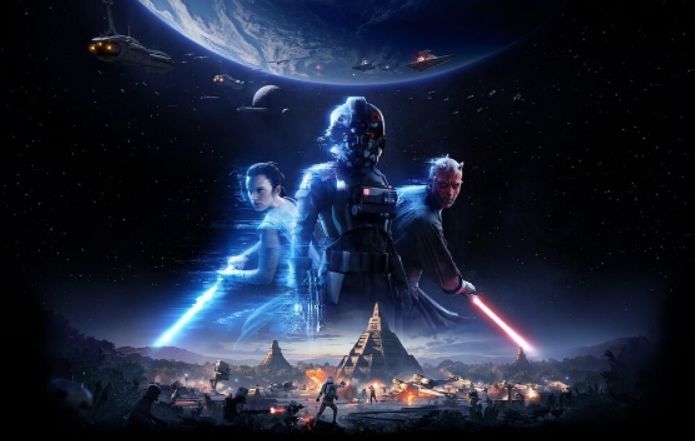
Battlefront widened the Star Wars social space from the person beside you to whole squads and battlefields full of other players. Image: Lucasfilm/EA via StarWars.com.
There is a lovely irony here. The earliest Star Wars arcade game attracted a crowd because one machine was scarce and spectacular. Online Star Wars games attract crowds because the machine is no longer the centre at all. Everybody has their own screen, their own controller and their own little rectangle of the galaxy. The social experience has become distributed.
Yet the old habits survive. Friends still sit in the same room while one person plays. Parents still watch children discover characters they met decades earlier. Somebody still gives unwanted tactical advice. Technology changes much faster than back-seat gaming etiquette.
The screen was never the whole story
There is something wonderfully revealing about the phrase “a Star Wars family”. It describes more than liking the same films. Franchises become family culture through repetition: toys on shelves, quotes at dinner, cinema trips, old controllers in drawers and games that one generation eventually hands to the next.
That is why the journey from arcade cabinet to couch matters. Videogames did not simply adapt Star Wars stories. They changed the social grammar of the franchise. The films said, “Look at this galaxy.” The games added, “Fine. Now who wants the controller?”
In 1983 that question might have been asked in a noisy arcade beside a glowing vector screen. In 1999 it could start an argument over a split-screen podrace. A few years later two people could rebuild the saga in LEGO while sitting on the same sofa. Today the person sharing the experience may be beside you or on the other side of the planet.
The hardware keeps changing. The social trick does not. Star Wars games keep finding new ways to turn an audience into participants, and participants into a group. Sometimes the Force binds the galaxy together. Sometimes it is just the second controller.
“The films said, ‘Look at this galaxy.’ The games added, ‘Fine. Now who wants the controller?’”
About the author
Søren Ahrensborg Kamper has written about Star Wars games, their history and the communities around them since 2009. He is the editor of Star Wars: Gaming.
Discover more from
Subscribe to get the latest posts sent to your email.
